The debate is rife on whether global native languages are at risk of disappearing with one dialect dying every fortnight (Chigbu, Chimaraoke & Walter pg 98-114). It is paramount that we do a lot to promote the use of local languages, whether we adopt other foreign dialects or not. It does not mean that we should shun English, but we should be careful not to compromise our native dialects. Therefore, this article will focus on whether studying in English should be mandatory in my country.
It is commonly regarded by people from my home country Oman that in today’s global dynamics mastering the Queen’s language is mandatory. Arabic is the country’s official language, but people use English widely. The English dialect is genuinely essential but not necessary. Many world leaders are successful, yet most of them do not see the need to use the language. Most of them do not possess the minimum know-how of the language, yet they make decisions on behalf of their nations. For example, Putin, the Russian president, cannot maintain a meaningful conversation in English, yet he leads one of the most powerful countries in the world. Therefore, we cannot base the success of these leaders on their knowledge of the English language but the expertise to make decisions.
English might be the preferred teaching language in my country, but we should not construe this notion to mean that after completing studies, success will be waiting. To be successful, hard work and determination are the key determinants. Nations around the world use the Queen’s language as the instruction language in all learning institutions from baby class to university. Still, the majority of these people are far from successful. Thus, the mandatory use of the English language will not mean a smooth sail to success.
World over, including my home country, there are a lot of successful people, and the only language they comprehend is the local dialect. Making English mandatory will only create a barrier to the majority of people in my country and globally. These barriers can be compared to racism when it comes to success. Many overcome these barriers while others do not, and those that conquer the hurdles spend many years trying to master the language. The years’ people use to learn the Queen’s language can be used at work or advancing research. Confining ourselves to the English language will also reduce the standard of our conversation. For example, world Economic powerhouse such as America has the world economy skewed in their favor and most of the discussion is about them, and they do not consider non-English speaking countries out there who are in dire need.
It is wrong for people to have a conviction that nations’ around the world that do not use English as the first language cannot generate influential personalities. Heading an institution such as the United Nations is no mean feat; it is a very compelling position that has been held by people from English non-speaking countries. Also, the Nobel peace prize has been held by different people around the world who have excelled in whatever they pursue. For example, in 2003, Shirin Ebadi from Iran was awarded the peace prize. These leaders never used English as their first language until they got to a certain level of education. Financial institutions’ like the IMF have also had influential people whose first dialect is not the Queen’s language, such as Christine Largade, who at the moment heads The European Central Bank (Luckhurst, pg 117-153).
Some skeptics believe that English is the key to success. They contend that the English language is used in 112 countries globally, with almost half a billion speakers and not confined like Mandarin. These people argue that English is the finance and business language that helps people to communicate quickly and carry out significant business dealings that would have been impossible without a common language (Nickerson, pg 390-404). They contend that large firms have established themselves around the world; thus, the need for a typical business language has risen. For example, large corporations such as Microsoft have made English their official dialect in Beijing.
In the entertainment industry, skeptics say that most books, top films, and music are produced in English, thus, the need for the Queen’s language. The skeptics say that English is best suited for this position. Further, these pessimists say that the world is a global village thanks to the internet. Around the world, people use the web for research, entertainment, learning, and more than 50 % of the material on the web is published using English; thus the need to learn and understand the Queen’s language (Al-Kadi, Abdu &Rashad, pg 727-736).
More people around the world are choosing to learn English more than any other language. The aftermath is that different dialects fall along the way. Studies show that every two weeks, a tongue slips into extinction. Also, parents in modern society rarely pass native languages to their children because modern society consumes them, and they do not feel the need to teach their children their native languages. The inclination to profit from economic advancement causes loss of local languages too since people identify more with significant languages such as English with opportunities and native dialects with slowness.
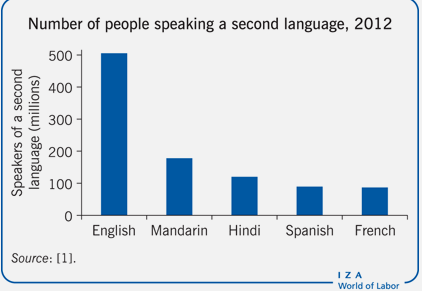
The above chart shows what many skeptics want to prove, that English is the second most preferred language after the local dialect. It is accurate and not wrong to have a second language so long as it does not erode the local languages. Learning a new language and even understanding the culture of the people speaking it is encouraged, but it should not be done in a manner that will put other local dialects in jeopardy. All languages world over should be treated without bias and protected from extinction.
Furthermore, if my country Oman decides to adopt English as the first language, it should not be at the expense of native dialects, including Arabic, the official language. For example, the internet language must not be English only. Translators can develop functions that will make it possible for everyone to speak and write in the language they are most comfortable with on the web. As a country, we should not allow English to dominate our native languages, however small. Preserving local languages plays an essential role in protecting the unique cultures of the world. For example, it will be devastating for Oman to lose its culture and heritage, which is majestically on display in cafes and the local dressing code of white robes by men and abayas for women. Loss of indigenous dialects will have adverse outcomes that people will only understand when it is too late.
According to UNESCO, between 1950 and 2010, 230 languages became extinct (Isern, Neus, &Joaquim). It is essential to preserve local languages because most spheres of a nation such as science, medicine, and the government depend partly on local traditional knowledge. When this knowledge ceases to exist, these important spheres are affected. When a language is extinct, its cultural diversity dies with it. Also, it is essential to note that UNESCO declared 2019 The Year of Indigenous Languages, and it shows how serious preserving these native languages has become (Morris).
Some cynics believe that English as a language does not erode local cultures by taking over from local dialects. They contend that the use of the Queen’s dialect is the second option in most countries. The people should use the native languages as the first option; thus, culture erosion is not possible. The skeptics also argue that UNESCO is doing a lot to protect heritages of the world; hence loss of native languages is impossible. UNESCO might be doing a lot to save many local dialects globally, but without the input of local communities, it will be a futile cause. Lastly, these skeptics may say that a language either dies when the last person of that ethnic group dies, which is rare or when the people who speak the language stop doing so.
In conclusion, it is essential to note that the mandatory use of English as a learning language does not guarantee success because there is proof that there are more billionaires in English non-speaking countries’. Protection of indigenous dialects, including Arabic, should not be compromised at any cost for the preservation of our national heritage. Instead, locals should be encouraged to teach their children local dialects. Most people prefer English, but it should not be at the expense of native languages. Also, governments’ should partner with international institutions to promote cultural diversity.
CITATIONS:
Morris, Miranda. “2019 UNESCO International Year of Indigenous Languages-The Modern South Arabian Languages.”
Al-Kadi, Abdu M. Talib, and Rashad Ali Ahmed. “Evolution of English in the internet age.” Indonesian Journal of Applied Linguistics 7.3 (2018): 727-736.
Chigbu, Uchendu, Chimaraoke O. Izugbara, and Walter T. de Vries. “Land, culture, culture loss and community: rural insights from sub-Saharan Africa.” The Routledge Handbook of Community Development. Routledge, 2017. 98-114.
Nickerson, Catherine. “The death of the non-native speaker? English as a lingua franca in business communication: A research agenda.” Language Teaching 48.3 (2015): 390-404.
Luckhurst, Jonathan. “Globalization, Inequality, and Challenges to Free Trade.” The Shifting Global Economic Architecture. Palgrave Macmillan, Cham, 2018. 117-153.
Isern, Neus, and Joaquim Fort. “Language extinction and linguistic fronts.” Journal of the Royal Society Interface 11.94 (2014): 20140028.
 Site Title