Be yourself; Everyone else is already taken.
— Oscar Wilde.
This is the first post on my new blog. I’m just getting this new blog going, so stay tuned for more. Subscribe below to get notified when I post new updates.
Be yourself; Everyone else is already taken.
— Oscar Wilde.
This is the first post on my new blog. I’m just getting this new blog going, so stay tuned for more. Subscribe below to get notified when I post new updates.
The debate is rife on whether global native languages are at risk of disappearing with one dialect dying every fortnight (Chigbu, Chimaraoke & Walter pg 98-114). It is paramount that we do a lot to promote the use of local languages, whether we adopt other foreign dialects or not. It does not mean that we should shun English, but we should be careful not to compromise our native dialects. Therefore, this article will focus on whether studying in English should be mandatory in my country.
It is commonly regarded by people from my home country Oman that in today’s global dynamics mastering the Queen’s language is mandatory. Arabic is the country’s official language, but people use English widely. The English dialect is genuinely essential but not necessary. Many world leaders are successful, yet most of them do not see the need to use the language. Most of them do not possess the minimum know-how of the language, yet they make decisions on behalf of their nations. For example, Putin, the Russian president, cannot maintain a meaningful conversation in English, yet he leads one of the most powerful countries in the world. Therefore, we cannot base the success of these leaders on their knowledge of the English language but the expertise to make decisions.
English might be the preferred teaching language in my country, but we should not construe this notion to mean that after completing studies, success will be waiting. To be successful, hard work and determination are the key determinants. Nations around the world use the Queen’s language as the instruction language in all learning institutions from baby class to university. Still, the majority of these people are far from successful. Thus, the mandatory use of the English language will not mean a smooth sail to success.
World over, including my home country, there are a lot of successful people, and the only language they comprehend is the local dialect. Making English mandatory will only create a barrier to the majority of people in my country and globally. These barriers can be compared to racism when it comes to success. Many overcome these barriers while others do not, and those that conquer the hurdles spend many years trying to master the language. The years’ people use to learn the Queen’s language can be used at work or advancing research. Confining ourselves to the English language will also reduce the standard of our conversation. For example, world Economic powerhouse such as America has the world economy skewed in their favor and most of the discussion is about them, and they do not consider non-English speaking countries out there who are in dire need.
It is wrong for people to have a conviction that nations’ around the world that do not use English as the first language cannot generate influential personalities. Heading an institution such as the United Nations is no mean feat; it is a very compelling position that has been held by people from English non-speaking countries. Also, the Nobel peace prize has been held by different people around the world who have excelled in whatever they pursue. For example, in 2003, Shirin Ebadi from Iran was awarded the peace prize. These leaders never used English as their first language until they got to a certain level of education. Financial institutions’ like the IMF have also had influential people whose first dialect is not the Queen’s language, such as Christine Largade, who at the moment heads The European Central Bank (Luckhurst, pg 117-153).
Some skeptics believe that English is the key to success. They contend that the English language is used in 112 countries globally, with almost half a billion speakers and not confined like Mandarin. These people argue that English is the finance and business language that helps people to communicate quickly and carry out significant business dealings that would have been impossible without a common language (Nickerson, pg 390-404). They contend that large firms have established themselves around the world; thus, the need for a typical business language has risen. For example, large corporations such as Microsoft have made English their official dialect in Beijing.
In the entertainment industry, skeptics say that most books, top films, and music are produced in English, thus, the need for the Queen’s language. The skeptics say that English is best suited for this position. Further, these pessimists say that the world is a global village thanks to the internet. Around the world, people use the web for research, entertainment, learning, and more than 50 % of the material on the web is published using English; thus the need to learn and understand the Queen’s language (Al-Kadi, Abdu &Rashad, pg 727-736).
More people around the world are choosing to learn English more than any other language. The aftermath is that different dialects fall along the way. Studies show that every two weeks, a tongue slips into extinction. Also, parents in modern society rarely pass native languages to their children because modern society consumes them, and they do not feel the need to teach their children their native languages. The inclination to profit from economic advancement causes loss of local languages too since people identify more with significant languages such as English with opportunities and native dialects with slowness.
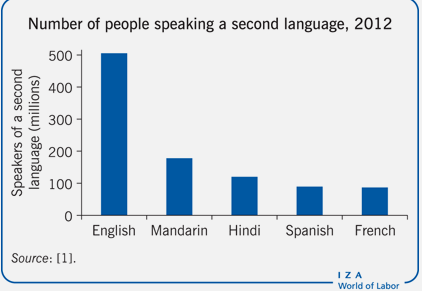
The above chart shows what many skeptics want to prove, that English is the second most preferred language after the local dialect. It is accurate and not wrong to have a second language so long as it does not erode the local languages. Learning a new language and even understanding the culture of the people speaking it is encouraged, but it should not be done in a manner that will put other local dialects in jeopardy. All languages world over should be treated without bias and protected from extinction.
Furthermore, if my country Oman decides to adopt English as the first language, it should not be at the expense of native dialects, including Arabic, the official language. For example, the internet language must not be English only. Translators can develop functions that will make it possible for everyone to speak and write in the language they are most comfortable with on the web. As a country, we should not allow English to dominate our native languages, however small. Preserving local languages plays an essential role in protecting the unique cultures of the world. For example, it will be devastating for Oman to lose its culture and heritage, which is majestically on display in cafes and the local dressing code of white robes by men and abayas for women. Loss of indigenous dialects will have adverse outcomes that people will only understand when it is too late.
According to UNESCO, between 1950 and 2010, 230 languages became extinct (Isern, Neus, &Joaquim). It is essential to preserve local languages because most spheres of a nation such as science, medicine, and the government depend partly on local traditional knowledge. When this knowledge ceases to exist, these important spheres are affected. When a language is extinct, its cultural diversity dies with it. Also, it is essential to note that UNESCO declared 2019 The Year of Indigenous Languages, and it shows how serious preserving these native languages has become (Morris).
Some cynics believe that English as a language does not erode local cultures by taking over from local dialects. They contend that the use of the Queen’s dialect is the second option in most countries. The people should use the native languages as the first option; thus, culture erosion is not possible. The skeptics also argue that UNESCO is doing a lot to protect heritages of the world; hence loss of native languages is impossible. UNESCO might be doing a lot to save many local dialects globally, but without the input of local communities, it will be a futile cause. Lastly, these skeptics may say that a language either dies when the last person of that ethnic group dies, which is rare or when the people who speak the language stop doing so.
In conclusion, it is essential to note that the mandatory use of English as a learning language does not guarantee success because there is proof that there are more billionaires in English non-speaking countries’. Protection of indigenous dialects, including Arabic, should not be compromised at any cost for the preservation of our national heritage. Instead, locals should be encouraged to teach their children local dialects. Most people prefer English, but it should not be at the expense of native languages. Also, governments’ should partner with international institutions to promote cultural diversity.
CITATIONS:
Morris, Miranda. “2019 UNESCO International Year of Indigenous Languages-The Modern South Arabian Languages.”
Al-Kadi, Abdu M. Talib, and Rashad Ali Ahmed. “Evolution of English in the internet age.” Indonesian Journal of Applied Linguistics 7.3 (2018): 727-736.
Chigbu, Uchendu, Chimaraoke O. Izugbara, and Walter T. de Vries. “Land, culture, culture loss and community: rural insights from sub-Saharan Africa.” The Routledge Handbook of Community Development. Routledge, 2017. 98-114.
Nickerson, Catherine. “The death of the non-native speaker? English as a lingua franca in business communication: A research agenda.” Language Teaching 48.3 (2015): 390-404.
Luckhurst, Jonathan. “Globalization, Inequality, and Challenges to Free Trade.” The Shifting Global Economic Architecture. Palgrave Macmillan, Cham, 2018. 117-153.
Isern, Neus, and Joaquim Fort. “Language extinction and linguistic fronts.” Journal of the Royal Society Interface 11.94 (2014): 20140028.
The debate is rife on whether global native languages are at risk of disappearing with one dialect dying every fortnight (Chigbu, et.al, pg 98-114). It is paramount that we do a lot to promote the use of local languages, whether we adopt other foreign dialects or not. It does not mean that we should shun English, but we should be careful not to compromise our native dialects. Therefore, this article will focus on whether studying in English should be mandatory in my country.
It is commonly regarded by people from my country that in today’s global dynamics mastering the Queen’s language is mandatory. The English dialect is genuinely essential but not necessary. Many world leaders are successful, yet most of them do not see the need to use the language. Most of them do not possess the minimum know-how of the language, yet they make decisions on behalf of their nations. Therefore, we cannot base the success of these leaders on their knowledge of the English language but the expertise to make decisions.
English might be the preferred teaching language in my country, but we should not construe this notion to mean that after completing studies, success will be waiting. To be successful, hard work and determination are the key determinants. Nations around the world use the Queen’s language as the instruction language in all learning institutions from baby class to university, but the majority of these people are far from successful. Thus, the mandatory use of the English language will not mean a smooth sail to success.
World over, some billionaires do not have a grasp of the English language. For example, according to a study conducted in 2013 by the Global Rich, Asia had more dollar billionaires’ than the United States (Wei, Ye, et al 77-85). Many nations’ in Asian do not recognize English as the first language ;hence with that in mind, it reflects that for anyone to accomplish a lot in life, he does not use English as a primary or learning language. These Asians use Mandarin yet they are in the billionaires club.
It is wrong for people to have a conviction that nations’ around the world that do not use English as the first language cannot generate influential personalities. Heading an institution such as the United Nations is no mean feat; it is a very compelling position that has been held by people from English non-speaking countries. These leaders never used English as their first language until they got to a certain level of education. Financial institutions’ like the IMF have also had influential people whose first dialect is not the Queen’s language such as Christine Largade who at the moment heads The European Central Bank (Luckhurst, 2018, pg 117-153).
Some skeptics believe that English is the key to success. These people argue that English is the finance and business language. They contend that large firms have established themselves around the world; thus the need for a common business language has risen.
The skeptics say that English is best suited for this position. Further, these pessimists say that the world is a global village thanks to the internet. More than fifty 50 % of the material on the web is published using English; thus the need to learn and understand the Queen’s language (Al-Kadi, et.al, 2018, pg 727-736).
More people around the world are choosing to learn English more than any other language. The aftermath is that different dialects fall along the way. Studies show that every two weeks a tongue slips into extinction. Also, parents in modern society rarely pass native languages to their children because modern society consumes them and they do not feel the need to teach their children their native languages. The inclination to profit from economic advancement causes loss of local languages too since people identify more with significant languages such as English with opportunities and native dialects with slowness.
Furthermore, if my country decides to adopt English as the first language, it should not be at the expense of native dialects. For example, the internet language must not be left to English only. Translators can develop functions that will make it possible for everyone to speak and write in the language they are most comfortable with on the web. As a country, we should not allow English to dominate our native languages, however small.
Preserving local languages plays an essential role in protecting the unique cultures of the world. Loss of indigenous dialects will have adverse outcomes that people will only understand when it is too late.
According to UNESCO, between 1950 and 2010, 230 languages became extinct (Isern, et.al, 2014). It is essential to preserve local languages because most spheres of a nation such as science, medicine, and the government depend partly on local traditional knowledge. When this knowledge ceases to exist, these important spheres are affected. When a language is extinct, its cultural diversity dies with it. Also, it is essential to note that UNESCO declared 2019 The Year of Indigenous Languages, and it shows how serious preserving these native languages has become (Morris, 2019).
Some cynics believe that English as a language does not erode local cultures by taking over from local dialects. They contend that the use of the Queen’s language is a second option in most countries. The native languages are used as the first option; thus culture erosion is not possible. The skeptics also argue that UNESCO is doing a lot to protect heritages of the world; hence loss of native languages is impossible. Lastly, these skeptics may say that a language either dies when the last person of that ethnic group dies, which is rare or when the people who speak the language stop doing so.
In conclusion, it is essential to note that the mandatory use of English as a learning language does not guarantee success because there is proof that there are more billionaires in English non-speaking countries’. Protection of indigenous dialects should not be compromised at any cost for the preservation of our national heritage. Most people prefer English, but it should not be at the expense of native languages. Also, governments’ should partner with international institutions to promote cultural diversity.
References:
Morris, Miranda. “2019 UNESCO International Year of Indigenous Languages-The Modern South Arabian Languages.”
Al-Kadi, Abdu M. Talib, and Rashad Ali Ahmed. “Evolution of English in the internet age.” Indonesian Journal of Applied Linguistics 7.3 (2018): 727-736.
Chigbu, Uchendu, Chimaraoke O. Izugbara, and Walter T. de Vries. “Land, culture, culture loss and community: rural insights from sub-Saharan Africa.” The Routledge Handbook of Community Development. Routledge, 2017. 98-114.
Wei, Ye, et al. “The rich-club phenomenon of China’s population flow network during the country’s spring festival.” Applied Geography 96 (2018): 77-85.
Luckhurst, Jonathan. “Globalization, Inequality, and Challenges to Free Trade.” The Shifting Global Economic Architecture. Palgrave Macmillan, Cham, 2018. 117-153.
Isern, Neus, and Joaquim Fort. “Language extinction and linguistic fronts.” Journal of the Royal Society Interface 11.94 (2014): 20140028.
The research on the effect of product variety on product sales has different variables involved. the results differ from each other depending on the type of variable put into consideration. Generally, production of different types of product increases the its sales. Product variety involves producing more different forms of a product. Different people have different preferences and opinions. For an organization to be able to cater for these differences, product variety is essential. By producing a variety of different products then the needs of many customers get fulfilled. Doing more research has opened up my mind to view the issue in a broader way by considering all the variables. The research has brought me to a better understanding of all the factors that influence the sales of a product. Product variety involves production of different products in terms of size, brand and even weight. Considering the product market, product variety has both positive and negative impact. In a large market population, product variety leads to increased sale. Producing a variety of products means increasing the stock of the same product. This situation may on the other hand lead to reduced stock out rates hence product surplus.
The main factor that determines the sales of a product is the market size and its composition. Some consumers do not focus on the product differentiation but its purpose. Therefore, it is important for an organization to study the market population before considering product variety as a factor to increases sales. In the article ‘effects of product variety and inventory on retain sales’ by Zeynep and Raman, product variety has much impact on its sales. Increasing the variety of a company’s products increases inventory levels which helps meet the customer needs. The article also shows the indirect negative impact of product variety on phantom product at store. the article ‘the impact of product variety on retailer operational performance and sales’ by Sweeney and Donald, confirm that for the sales of a product to increase there are several factors to be considered. There are other impacts that come along with product variety. Product variety leads to increased inventory levels which require management costing the organization some money. It also confirms that despite the fact that product variety increases retail sales, it also increases the operational performance of a business. A store located in a low market area is likely to incur loses by increasing products due to increased operational cost.
References
Ton, Zeynep, and Ananth Raman. “The effect of product variety and inventory levels on retail store sales: A longitudinal study.” Production and Operations Management 19.5 (2010): 546-560.
Sweeney, Kevin Donald. THE IMPACT OF PRODUCT VARIETY ON RETAILER OPERATIONAL PERFORMANCE AND SALES: EVIDENCE FROM CHINA. Diss. 2015.
In the article ‘the impact of technology on form’s production efficiency, product quality and productivity’ by Matt and Jim confirms that technology has great influence on the productivity of a firm. The use of new technologies in the production of a firm leads to increased gains and profits. This case is due to the improved ways of tackling difficult tasks and improved product developments that come along with new technologies. New technology leads to increased production efficiency and productivity of a firm through product quality development. The article demonstrates how information technology provides low input in production leading to high output thus high productivity. The article also explains how technology does not always lead to increased profits in a firm. Investment in some advanced forms of technology may lead to decreased productivity of an organization. the information provided in this article is credible enough since it provides clarity to the assumption that technology always increases a firm’s productivity. The article descries that the productivity of a firm is determined by other factors apart from technology.
Haeffner, M., & Panuwatwanich in their article ‘Perceived impacts of Industry 4.0 on manufacturing industry and its Workforce’ confirms that technology improves the production in a firm. A firm’s production process is basically determined by the customer needs. Change in technology influences the customer needs thus influencing the manufacturing process of certain products. New technologies demand for product development to meet the customer needs. This article describes how firms are forced to change their workforce to more skilled workers who can manufacture the developed products. With the use of computerized systems in firms the manufacturing process has become more effective and efficient. Therefore, the firm is able to enjoy increased profits since the products fit customers preferences. Improved technology lead to quality production in a firm.
References
Haeffner, M., & Panuwatwanich, K. (2017, September). Perceived impacts of Industry 4.0 on manufacturing industry and its Workforce: Case of Germany. In International conference on engineering, project, and product management (pp. 199-208). Springer, Cham.
Thatcher, M. E., & Oliver, J. R. (2001). The impact of technology investments on a firm’s production efficiency, product quality, and productivity. Journal of Management Systems, 18(2), 17-45.
In the article ‘effects of product variety and inventory on retain sales’ by Zeynep and Raman, product variety has much impact on its sales. The article examines the effect of the product variety and inventory levels on sales. Product variety involves producing more different forms of a product. Different people have different preferences and opinions. For an organization to be able to cater for these differences, product variety is essential. By producing a variety of different products then the needs of many customers get fulfilled. This article confirms that increasing a product variety increases its sales thus increased profits to retail shops. the information obtained from this article is credible enough to provide prove on the specific impact of brand verity on company sales. Increasing the variety of a company’s products increases inventory levels which helps meet the customer needs. The article also shows the indirect negative impact of product variety on phantom product at store. Sweeney and Donald in the article ‘the impact of product variety on retailer operational performance and sales’ confirm that product variety increase the amount of sales made in a retail business. The article examines the effect product variety has on inventory levels, stock out rates and sales. When different products are produced the inventory levels increase. This case requires a complex management system to monitor and control the inventory. There are more complications involved with product variety in an organization. chain supply management becomes complex. The article shows the different relationship of brand, size and product line variety to inventory levels and sales. It also confirms that despite the fact that product variety increases retail sales, it also increases the operational performance of a business. There is increased operations in an organization when it produces a variety of products to meet customer needs.
Reference
Ton, Zeynep, and Ananth Raman. “The effect of product variety and inventory levels on retail store sales: A longitudinal study.” Production and Operations Management 19.5 (2010): 546-560.
Sweeney, Kevin Donald. THE IMPACT OF PRODUCT VARIETY ON RETAILER OPERATIONAL PERFORMANCE AND SALES: EVIDENCE FROM CHINA. Diss. 2015.
Research question: Doe legalization of some less harmful drugs reduce crime in our societies?
There has been confusion among some people on the relation of drug abuse and crime rate in our societies. Most people link some crimes to drugs. Some people commit crimes such as theft and fraud to get money for drugs. This case increases the rate of crimes in our societies. There are many crimes related to drug abuse in the society thus the need to conduct this research. The research helps determine what crimes are as a result of drug abuse and how to reduce them through dug legalization. When a drug is legalized, it means that using the drug is not a crime anymore. Legalization of some less harmful dugs such as alcohol and marijuana lessen the rate of crimes in our community. Many people go to jail for abusing and selling illegal drugs. If the less harmful drugs are legalized the people abusing or selling them do no go to prison. On one hand legalization of some drugs reduces crimes in the society. For example, if the use of marijuana is legalized then people using it are not criminals. Whenever there is medical law for the drug legalization most crimes related to the drug such as smuggling and violence get reduced. Sometimes legalization of a drug subjects it to laws and regulations which may make I difficult for people to access. In this case the rate of crime is reduced. While on the other hand legalization of some drugs increases crime in the society. When a drug like marijuana is legalized more people tend to abuse the drug. As mentioned earlier, most crimes are related to drug abuse. People are prone to crimes such murder or theft while under the influence of drugs. Some even commit crimes to get the drugs. To some extent legalization of some drugs leads to increased crime rates in our communities. From some of the previous research study, it is evident to say that most criminals are usually under the influence of drugs during a crime. For an effective research results, first hand information is essential. This is because it provides first hand data which more reliable and accurate. For this kind of data to be obtained, it is advisable to heavily depend on primary sources of information such as conducting field study.
A community is a group of people who share the same values, interests and inspirations in life. People in a community have many things in common such as language, culture and purpose which keeps them united. One can be in more than one group depending on their level of socialization and environment. Therefore, a person may have the power to choose their communities or not. I associate with several communities mainly in the religion, Miami youths, first aid, football and the college student leaders.
The religion community I belong to is very important to me because it is where I have made true and longtime friends. In the community, I have learnt to remain calm, loving and other important moral values. However, as young people, we are losing the grip of the religious teachings because of civilization, technology and formal education. Atheism is becoming popular as people choose to believe that there is no supreme being and everything credited to Him is a result of science. As a community, we have been concerned about this issue because the faith was passed on from our forefathers and we strongly believe in the existence of a supreme being. Therefore, we are working hard to pass on relevant religious knowledge related to our religion to ensure that we are not losing young people to atheism.
I also belong to the creative community in our state. The community is made up of drawing artists, dancers and poets. We use the various methods to express the desires, ambitions and the unspoken struggles of young people in the competitive world. In the community, several significant issues are worth looking at. First, some members of our community engage in drug abuse. We are all raised and socialized in different backgrounds and there are some members who hide in drug and substance abuse as a way to get relieve from the daily pressures of life. This has affected their performance in the area of specialization and it is challenging to achieve the objectives and goals of the community. Secondly, some members are stagnant with their projects for lack of exposure and the increased competition within and without the community. As a community, we are not making significant growth with the various projects in the last seven months. Some members find it difficult to cooperate with others in the community because they want to receive full credit for the projects. This has led to stagnation because there are few or no exchange of ideas in the community. Therefore, the community has not been as competitive as it used to be years ago.
In conclusion, a community is a part of a society made of people sharing goals, ambitions and going through similar challenges. One can be in a community voluntarily or involuntarily. Every community faces different challenges and issues which need urgent or timely attention if the community has to remain intact maintaining its direction and fulfilling its purpose.
This is an example post, originally published as part of Blogging University. Enroll in one of our ten programs, and start your blog right.
You’re going to publish a post today. Don’t worry about how your blog looks. Don’t worry if you haven’t given it a name yet, or you’re feeling overwhelmed. Just click the “New Post” button, and tell us why you’re here.
Why do this?
The post can be short or long, a personal intro to your life or a bloggy mission statement, a manifesto for the future or a simple outline of your the types of things you hope to publish.
To help you get started, here are a few questions:
You’re not locked into any of this; one of the wonderful things about blogs is how they constantly evolve as we learn, grow, and interact with one another — but it’s good to know where and why you started, and articulating your goals may just give you a few other post ideas.
Can’t think how to get started? Just write the first thing that pops into your head. Anne Lamott, author of a book on writing we love, says that you need to give yourself permission to write a “crappy first draft”. Anne makes a great point — just start writing, and worry about editing it later.
When you’re ready to publish, give your post three to five tags that describe your blog’s focus — writing, photography, fiction, parenting, food, cars, movies, sports, whatever. These tags will help others who care about your topics find you in the Reader. Make sure one of the tags is “zerotohero,” so other new bloggers can find you, too.

 Site Title